How to Choose a Crystal Singing Bowl Set

Choosing a crystal singing bowl set is not only about finding beautiful bowls.
It is about finding a group of tones that work well together.
A strong set has relationship: between notes, octaves, tuning, timbre, sustain, and the way the bowls interact when they are played together.
The right set depends on how you plan to use it, whether you are beginning from scratch or adding to bowls you already own, and the kind of sound you want to create.
At Bowls of Sound, we record the individual bowls so you can listen before choosing and compare how different instruments sound together.
Choosing your first individual bowl instead? Start with our How to Choose a Crystal Singing Bowl guide.
Start With How You Will Use the Set
Before choosing notes, begin with purpose.
A set for personal meditation may be very different from a set used for group sound healing, yoga, travel, or recording.
Personal Meditation
You may not need a large set.
One bowl can be a complete practice, while a carefully chosen three bowl set can create more tonal movement without becoming complicated.
Yoga or Group Practice
Consider:
- Ease of playing
- Volume control
- Portability
- How easily the bowls can be transported
- Whether the sound projects comfortably through the room
Sound Healing
A larger set can create more range, contrast, and movement.
You may want:
- A deeper foundational tone
- Several middle range voices
- One or more brighter tones
- Musical relationships that allow you to move naturally between bowls
Recording or Playing With Other Instruments
Exact tuning becomes more important.
Note, octave, Hz, cents, and the relationship to other tuned instruments may deserve more attention here than they would in a purely personal meditation practice.
How Many Crystal Singing Bowls Should Be in a Set?
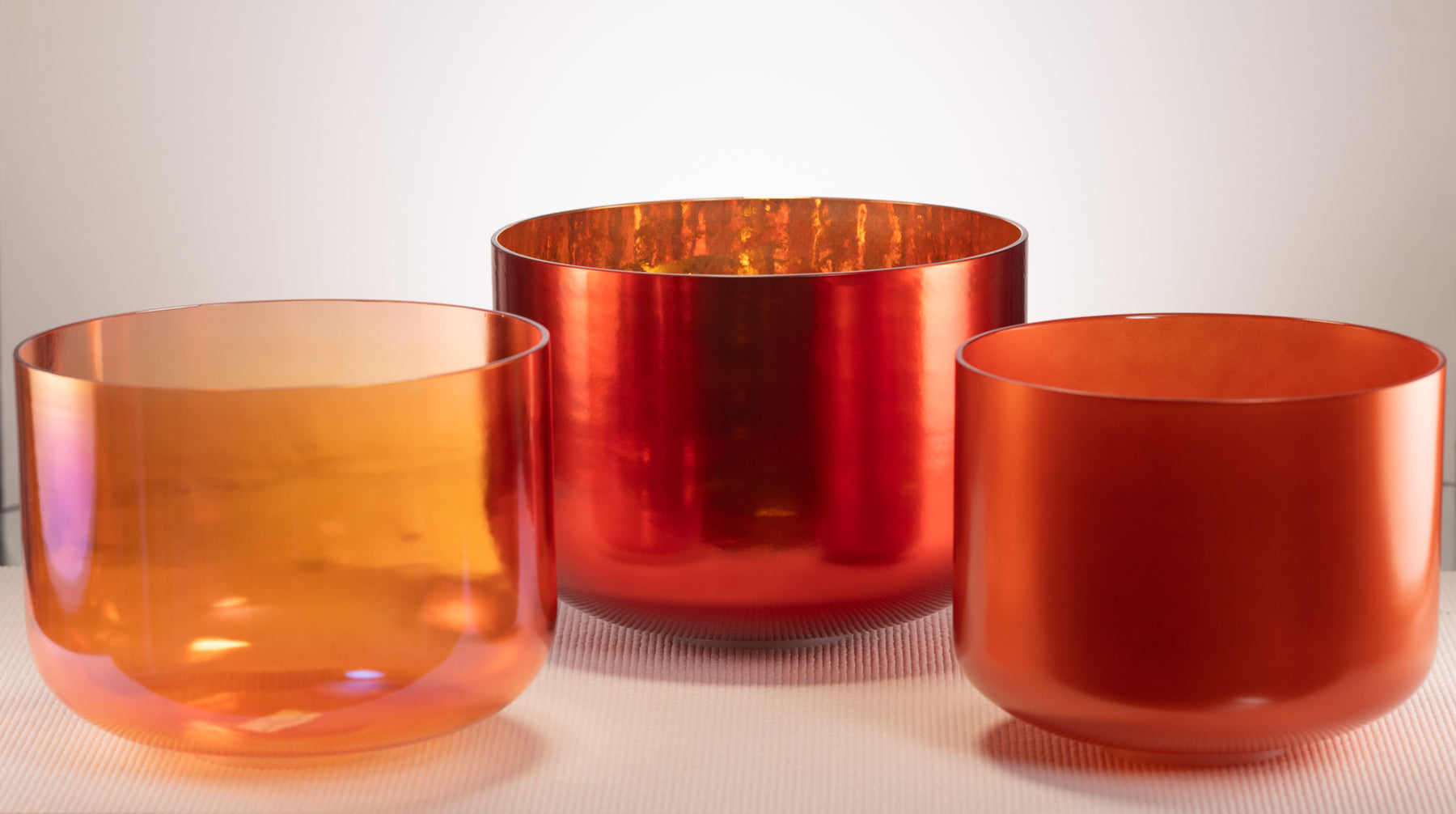
There is no required number.
A set can contain:
- Two bowls
- Three bowls
- Four or five bowls
- Seven bowls
- A larger custom collection
More bowls do not automatically create a better set.
Two-Bowl Sets
Two bowls can create a simple musical relationship such as:
- An octave
- Perfect fifth
- Perfect fourth
- Third
- Monaural pulsing
A pair can be surprisingly expressive.
Three-Bowl Sets

Three bowls are a wonderful place to begin exploring harmony.
One common approach is a major or minor triad.
A major triad often has a more happy or bright musical quality.
A minor triad often has a more contemplative or darker musical quality.
Examples:
| Root | Major Triad | Minor Triad |
|---|---|---|
| C | C – E – G | C – E♭ – G |
| D | D – F# – A | D – F – A |
| E | E – G# – B | E – G – B |
| F | F – A – C | F – A♭ – C |
| G | G – B – D | G – B♭ – D |
| A | A – C# – E | A – C – E |
The note names provide a useful map.
The actual bowls still need to be heard together.
Seven-Bowl Sets
Seven bowls can create a broader tonal landscape, but a seven bowl set does not have to contain one of every note.
Some sets use:
- C through B
- Chord relationships
- Pentatonic relationships
- Layered octaves
- Repeated notes in different octaves
- A combination built around one central bowl
A set does not have to follow a predetermined formula to feel complete.
How Notes Work Together
When bowls are played together, you are listening to the relationship between frequencies.
Some intervals sound stable and open.
Others create more tension or movement.
Common relationships to explore include:
- Octave
- Perfect fifth
- Perfect fourth
- Major third
- Minor third
- Major or minor triad
- Pentatonic relationships
- Monaural Pulsing
A bowl may sound beautiful alone but not create the relationship you want within a particular set.
This is why choosing a set only by color, note name, or appearance can be limiting.
You are not simply collecting notes.
You are building relationships between sounds.
Why Octave Matters
The same note can exist in several octaves.
A C in the 3rd octave and a C in the 4th octave are both C notes, but they occupy different pitch ranges.
Lower octaves generally bring deeper tones.
Higher octaves generally bring higher, brighter tones.
A set containing more than one octave can create greater range and contrast.
Layering the Same Note Across Octaves
One useful set-building approach is pairing the same note in different octave ranges.
For example:
C3 + C4
or:
F3 + F4
At Bowls of Sound, we use the term Sound Symmetry for intentionally exploring these same note relationships across octave ranges.
One bowl may provide depth while another brings a higher voice.
You do not necessarily need seven different notes to create a rich set.
What Do Hz and Cents Tell You?
Each bowl has a measurable fundamental frequency in Hz.
From that frequency, you can identify:
- Note
- Octave
- Position in cents relative to note center
Cents
Cents describe small differences in musical pitch.
For example:
A +10 cents
is slightly above the note center used as the reference.
A -20 cents
is slightly below it.
Cents can become useful when you are matching bowls closely, building specific intervals, recording, or playing with other tuned instruments.
They should not replace listening.
Perfect Pitch / True Tone
At Bowls of Sound, Perfect Pitch and True Tone refer to bowls falling within approximately ±10 cents of note center under the tuning reference being used.
Being close to note center can be useful when precise pitch relationships matter.
It does not automatically mean the instrument sounds better.
For a deeper explanation, visit our Crystal Singing Bowl Notes, Hz, Octaves & Cents Tuning Guide.
Building Around a Bowl You Already Own

If you already have one or more bowls, begin with them.
Identify each bowl's:
- Note
- Octave
- Hz
- Cents
If you know the frequency but are unsure of the note, use our Hz to Note Finder.
Then ask what you want the next bowl to add.
You might want:
- A deeper foundation
- A higher voice
- Another octave
- A perfect fifth
- A third
- A fourth
- A close-frequency relationship
- A different timbre
- More contrast
You do not need to purchase the next missing note simply because it is missing.
Sometimes the strongest addition is a bowl that deepens a relationship already present in the set.
A Practical Way to Compare Bowls Online
One of the advantages of individual bowl recordings is that you can compare potential combinations before purchasing.
If you are on a computer:
- Open the recordings of the bowls you are considering in separate tabs.
- Begin one recording.
- Start another while the first is sustaining.
- Listen to the relationship.
- Try the combination more than once.
Notice:
- Whether the pitches blend
- Whether you hear musical tension or ease
- How their sustain overlaps
- Differences in volume
- Differences in timbre
- Audible beating or pulsing
- Whether one instrument overwhelms the others
- Whether you simply enjoy the combination
Use good-quality headphones or full-range speakers when possible.
Phone and laptop speakers can make deeper bowls sound thinner than they are.
No recording can reproduce exactly what several physical bowls will sound like together in your room, but listening this way can be very useful for narrowing a set.
Close-Frequency and Monaural Pairings
Two bowls with frequencies close to one another can create audible beating when sounded together in the same acoustic space.
You may hear the sound rise and fall in intensity as the two frequencies interact.
This is commonly described as acoustic beating or a monaural beating effect.
It is different from a binaural beat, which refers specifically to different tones being presented separately to the left and right ears.
Close frequency pairs can be fascinating to hear and the amount and speed of the pulsing depend on the difference between the frequencies.
What Size Bowls Should You Choose?
Size matters primarily for:
- Portability
- Physical space
- Weight
- Nesting
- Playing position
Larger bowls often but not always are in lower pitch ranges.
Smaller bowls often but not always are in higher pitch ranges.
Diameter alone does not determine note or octave.
For a set that travels frequently you should consider whether bowls can safely nest with appropriate padding.
For a permanent studio larger instruments may be nice to habve because portability matters less.
Let size support the way you will actually use the set.
Do not choose the musical relationship from diameter alone.
Frosted, Clear, or Alchemical Bowls in a Set
Sets can be built entirely from one bowl type or from a mixture of styles.
Frosted Bowls
Frosted bowls often provide:
- Strong fundamental tones
- Good projection
- Broad availability
- More accessible pricing
They can be particularly practical when building a larger set.
Clear, White Light, and Alchemical-Style Bowls
These bowls can vary considerably in:
- Timbre
- Overtone structure
- Sustain
- Responsiveness
- Construction
They may also carry a higher price because of materials and production methods.
Neither category automatically creates a better set.
The question is whether the individual instruments work together.
For a detailed comparison, see our Frosted vs. Clear Crystal Singing Bowls guide.
Common Mistakes When Building a Crystal Singing Bowl Set
Choosing Only by Color
Visual harmony does not guarantee musical harmony.
Let appearance be part of the choice, but listen to the bowls together.
Choosing Only by Chakra Note
A C-through-B sequence is one valid approach, but it is not the only approach.
A set can also be built around chords, octaves, fifths, pentatonic relationships, or another musical structure.
Ignoring Octave
Two bowls can share the same note letter while occupying very different pitch ranges.
Always look at the octave as well as the note.
Ignoring Cents When Precise Matching Matters
Cent position becomes particularly useful when recording, working with tuned instruments, or intentionally matching pitches.
Choosing Individual Bowls Without Listening to the Whole
A beautiful individual bowl does not automatically strengthen a set.
Listen to what it contributes to the group.
Assuming Bigger Is Better
A carefully chosen three-bowl set can be more musically satisfying than a larger collection without a clear relationship.
Buying a Full Set Before You Know What You Like
For some people, a complete set is the right beginning.
For others, starting with two or three bowls allows preferences to emerge naturally before making a larger investment.
Crystal Singing Bowl Set FAQ
What is the best crystal singing bowl set for a beginner?
There is no single best beginner set.
A small frosted set can be an accessible option because frosted bowls are generally straightforward to play and more affordable.
A well-matched three-bowl set can also be a beautiful starting point because it introduces harmony without requiring a large collection.
How many crystal singing bowls should be in a set?
There is no required number.
Two bowls can form a pair, three can create a chord, seven can create a wider tonal palette, and larger sets can be built for professional use.
Choose the number that fits your purpose and budget.
Does a seven-bowl set need all seven notes?
No.
A seven-bowl set can contain C through B, but it can also use repeated notes in different octaves, chords, fifths, pentatonic relationships, or another intentional structure.
Should all bowls in a set be in the same octave?
No.
Many sets use multiple octave ranges to create depth and contrast.
A same-octave set can also work beautifully if that is the sound you prefer.
Do all the bowls need to have similar cents?
Not necessarily.
Similar cent direction can sometimes be useful, particularly when precise tuning relationships matter, but it is not a universal rule for a beautiful set.
Listen to the actual instruments together.
Are Perfect Pitch bowls better for a set?
Not automatically.
They can be useful when playing with musicians or other precisely tuned instruments.
For sound healing or personal use, the relationship between the individual bowls may matter more than whether every bowl is close to note center.
Can I build a set around a bowl I already own?
Yes.
Start by identifying its note, octave, Hz, and cents, then explore intervals or octave relationships that complement it.
Can I listen to multiple bowls together before buying?
Yes.
At Bowls of Sound, individual bowl recordings allow you to compare instruments online.
Playing recordings together can help you hear possible relationships before purchasing, although it cannot completely reproduce having the physical bowls together in the same room.
Need Help Building a Crystal Singing Bowl Set?

If you are building a set and want help comparing bowls, we are happy to assist.
We can help you explore:
- Three-bowl combinations
- Chords
- Octave relationships
- Perfect fifths and other intervals
- Close-frequency pairs
- Bowls that complement instruments you already own
- Larger professional sets
Knowing the note, octave, Hz, and cents of bowls you already own can be helpful, but you do not need to arrive with everything figured out.
Sometimes listening to a few combinations side by side is the clearest place to begin.
Continue Exploring
How to Choose a Crystal Singing Bowl
Choose an individual bowl by sound, size, note, octave, type, and intended use.
How to Choose the Right Note for a Crystal Singing Bowl
Explore note selection, octave, Hz, cents, and musical relationships.
Crystal Singing Bowl Notes, Hz, Octaves & Cents Tuning Guide
Understand the technical side of tuning and pitch relationships.
Hz to Note Finder
Enter a frequency to identify its note, octave, and cents.
Shop Crystal Singing Bowl Sets
Listen to curated crystal singing bowl sets and explore different harmonic relationships. Bowls of Sound
Written by Tara Kaur & Joshua Esquivel | Bowls of Sound, Sedona, Arizona