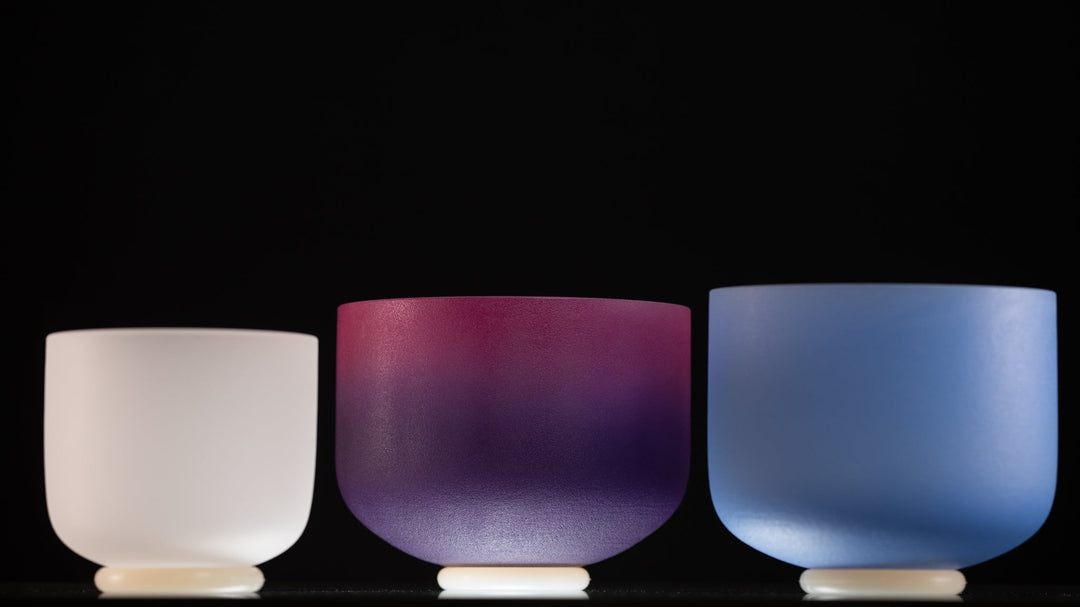
How to Choose a Crystal Singing Bowl
Choosing a crystal singing bowl can feel surprisingly complicated.

There are different sizes, notes, octaves, styles, colors, tuning measurements and price points. Some bowls are machine made, while others are individually shaped by hand. Some have a clear, prominent fundamental tone, while others develop a more complex overtone structure as they are played.
But choosing a bowl does not have to begin with all of that information.
A good place to start is much simpler:
Listen.
The sound of the bowl should matter.
If you find yourself wanting to keep listening, that response is worth paying attention to.
From there, you can narrow the possibilities according to how you plan to use the bowl, the type of instrument you prefer, its size, note, octave and tuning, and how it may relate to bowls you already own.
There Is No Single Best Crystal Singing Bowl
The best crystal singing bowl for one person may not be the best choice for someone else.
Someone choosing a first bowl for personal meditation may have very different priorities from a practitioner building a larger sound healing set.
You might care most about:
-
The sound and resonance
-
How easy the bowl feels to play
-
Size and portability
-
Whether you prefer a lower or higher pitch
-
The type and style of bowl
-
Note, octave, Hz and cents
-
How it sounds with bowls you already own
-
How you plan to use it
-
Budget
There is no required first note, size or style.
You also do not need to choose a bowl simply because a chart associates a particular note with a chakra.
A chakra association can be one way to explore a bowl, but it does not need to determine your choice.
Technical information can help you understand an instrument and compare your options, but it does not need to replace listening.
Start With the Actual Bowl
When shopping online, listen to a recording of the individual bowl you are considering whenever possible.
Two bowls that look almost identical on paper can still have noticeably different voices because of differences in pitch, construction, wall thickness, sustain, timbre and overtone structure.
At Bowls of Sound, we record the individual bowls so you can hear the specific instrument available rather than relying on a generic sound sample for that type or style.
Use good-quality speakers or headphones when possible and begin at a comfortable volume.
Phone and laptop speakers often struggle to reproduce the deeper frequencies and full overtone character of some crystal singing bowls, so what you hear through them may not represent the entire sound of the instrument.
The specifications can help you narrow the choices.
The sound can help you decide.
New to crystal singing bowls? Visit our Start Here guide for a simple overview of where to begin.
Start With How You Will Use the Bowl
How you plan to use your crystal singing bowl can quickly narrow the possibilities.
There is no single bowl that is best for every person or every practice.
For Personal Meditation or Home Use
If you are choosing a bowl for meditation, relaxation or personal practice, begin with a sound you genuinely enjoy.
You do not need a particular note or size.
Think about:
-
How much space you have
-
Whether you prefer a deeper or higher pitch
-
How easy the bowl feels to play
-
Whether you prefer a clear, simple voice or a more complex overtone character
For many people, one well-chosen bowl is enough to begin.
For Yoga, Breathwork or Group Practice
If you plan to use a bowl for yoga, pranayama or small group practice, consider how easily its sound projects through the room.
Projection, sustain and ease of playing may matter more here than choosing a particular note.
You may also want a bowl that responds easily and can be started and stopped cleanly, especially if you use sound to mark transitions within a practice.
For Sound Healing or Professional Sessions
If you are building a professional sound practice, think less about finding one “perfect” bowl and more about how the instrument fits with the bowls and other instruments you already use.
Consider:
-
The pitch range you already have
-
Whether you need a deeper or higher voice
-
How the bowl blends with gongs, chimes or other instruments
-
Its note, octave, Hz and cents
-
Its timbre, sustain and overtone structure
-
How responsive it is at different playing intensities
A bowl with a complex overtone character may be useful in one setting, while a clear, prominent fundamental may be exactly what another session calls for.
For Travel or Mobile Use
If you travel with your instruments, size and weight become especially important.
A smaller bowl may be easier to transport, but smaller does not automatically mean better for your practice.
Consider the pitch, sound character, ease of playing and how the bowl fits with the other instruments you travel with.
Handheld crystal singing bowls can also be useful when you want to move with the sound rather than keep the instrument stationary.
Which Type of Crystal Singing Bowl Should You Choose?
One of the important differences between crystal singing bowls is how they are made.
Manufacturing methods vary between producers, so not every bowl fits neatly into a single category. But when comparing instruments, it can be helpful to understand two broad approaches commonly found in crystal singing bowls: standardized molded bowls and individually hand-shaped bowls.
Machine-Made Frosted Crystal Singing Bowls

Many standard frosted crystal singing bowls are produced from fused quartz using relatively standardized forming processes.
This type of production can create greater consistency in dimensions and construction from one bowl to another, although individual instruments can still differ in pitch, sustain and overall sound.
Many frosted bowls have a clear, prominent fundamental pitch and a powerful, direct voice.
Depending on the manufacturer and style, frosted bowls may also incorporate colorants, minerals, metals or other added materials or finishes.
Frosted bowls are often:
-
More affordable
-
Powerful in volume and projection
-
Relatively consistent in construction
-
Available in many notes and sizes
-
A practical choice for a first bowl or larger set
A well-made frosted bowl can be a beautiful instrument.
Less expensive does not necessarily mean lower quality or less useful.
Hand-Shaped Clear, White Light and Alchemical Bowls

Many clear, White Light and alchemical-style crystal singing bowls are produced using a more individualized forming and finishing process.
Hand-shaped bowls may be formed from fused-quartz stock, which can include quartz tubing, and then heated, shaped and finished individually.
Because more of the final form is created during this individual shaping process, there can be greater variation from one instrument to another.
Differences in wall thickness, shape, diameter and construction can influence the bowl's:
-
Fundamental pitch
-
Overtone structure
-
Timbre
-
Sustain
-
Responsiveness
-
Overall sound character
Some hand-shaped bowls develop a more complex overtone character as they are played. A clear fundamental may be accompanied by additional upper frequencies that become more noticeable as the bowl begins to resonate.
Some players also prefer the responsiveness of hand-shaped bowls and find them easy to bring into a sustained rim tone.
White Light, alchemical and other specialty bowls may incorporate minerals, metals, colors and distinctive surface treatments or finishes, creating even more variation between individual instruments.
Because these bowls can require more individualized forming, finishing, specialized materials and production, they are generally more expensive than standard frosted bowls.
Neither Type Is Automatically Better
A more expensive or more complex bowl is not automatically the right bowl for you.
You may love the strong, direct voice of a frosted bowl.
Or you may prefer the responsiveness, sustain and layered overtone character of a hand-shaped clear, White Light or alchemical bowl.
Both can be beautiful instruments, and both can have a place in personal practice, meditation or a larger sound healing set.
This is another reason we recommend listening to the actual individual bowl whenever possible rather than choosing from its appearance, material, price or specifications alone.
The way a bowl is made can tell you something about the instrument.
Listening tells you whether you love its voice.
For a deeper comparison, see our Frosted vs. Clear Crystal Singing Bowls guide.
Should You Start With One Bowl or a Bowl Set?
For many people, one crystal singing bowl is enough to begin.
Starting with a single bowl gives you time to learn how the instrument responds, how much pressure and playing speed it needs, and what you personally enjoy about its sound.
It can also help you discover your preferences before investing in several bowls.
Over time, you may notice that you are drawn toward:
-
Deeper or higher pitches
-
A clear, prominent fundamental or a more complex overtone character
-
Longer sustain
-
Particular bowl styles
-
Certain musical intervals or relationships between notes
There is no requirement to begin with a complete chakra set or a bowl in every note.
When a Set May Make More Sense
A set can be a good choice if you already know that you want to work with several tones together, particularly for sound healing sessions, yoga, meditation groups or a professional practice.
But a set does not have to contain every note from C through B to sound complete.
A few carefully chosen bowls with musical relationships you genuinely enjoy may be more satisfying than simply collecting one of every note.
Those relationships might include:
-
Octaves
-
Perfect fifths
-
Thirds
-
Fourths
-
Close-frequency pairings
-
Other intervals that sound beautiful to you
If you are building a set from the beginning, our How to Choose a Crystal Singing Bowl Set guide goes much deeper into choosing bowls that work well together.
If You Already Own a Bowl
If you already have one or more bowls, start with what you own rather than simply searching for a missing note.
Identify the note, octave, frequency in Hz and cents of your existing bowls whenever possible.
Then consider what you would like the next bowl to add to the sound you already have.
It may be another note that expands the musical range.
It could be the same note in a different octave, or another bowl that creates an intentional relationship across different octaves and pitch ranges.
At Bowls of Sound, we use the term Sound Symmetry for exploring these kinds of relationships.
Or you may simply discover a bowl whose voice, overtone character or timbre sounds beautiful with the instruments you already own.
The set does not have to follow a predetermined formula.
Listen for the relationship you want to hear.
What Size Crystal Singing Bowl Should You Choose?

Size matters, but it should not be considered by itself.
In general, larger crystal singing bowls tend to produce lower pitches, while smaller bowls tend to produce higher pitches.
But diameter alone does not determine the note or octave.
Wall thickness, shape, construction and other physical characteristics also influence the bowl's final pitch and sound.
Larger Crystal Singing Bowls
Larger bowls often offer:
-
Deeper fundamental tones
-
A larger physical and sonic presence
-
Strong projection in many instruments
-
Long sustain in some designs
They can be especially appealing if you enjoy lower frequencies or want to add more depth to an existing collection.
The tradeoff is practical: larger bowls require more space and are generally heavier and less convenient to transport.
Smaller Crystal Singing Bowls
Smaller bowls are often:
-
Easier to carry
-
Easier to position in a smaller room
-
Useful for travel or mobile sound work
-
Higher in pitch than larger bowls, in general
But a smaller bowl is not automatically quieter, and a larger bowl is not automatically better.
The individual instrument still matters.
Choose by Sound, Not Diameter Alone
Two bowls with the same diameter can still differ in:
-
Note
-
Octave
-
Hz
-
Cents
-
Timbre
-
Sustain
-
Overtone structure
That is why we recommend considering size together with the bowl's actual sound and tuning information rather than choosing by diameter alone.
If portability matters most, begin by narrowing the size range.
If sound is the priority, listen first, then make sure the bowl's size works comfortably for your space and the way you plan to use it.
What Note Should You Choose?
There is no required first note for a crystal singing bowl.
You do not need to begin with C, choose a note because of a chakra chart, or select a specific frequency unless you have a particular musical, tuning or practical reason for doing so.
Start by listening to several bowls and notice which sounds you genuinely enjoy.
Note Is Only Part of the Picture
A note name by itself does not tell you everything about a bowl.
Two bowls with the same note name can still sound very different because they may differ in:
-
Octave
-
Measured frequency in Hz
-
Cents above or below note center
-
Size and wall thickness
-
Timbre
-
Sustain
-
Overtone structure
-
Construction
So we do not recommend choosing a crystal singing bowl by note letter alone.
If you want to understand the technical side more deeply, including how note, Hz, octave and cents work together, see our Crystal Singing Bowl Notes, Hz, Octaves & Cents Tuning Guide.
It includes a complete frequency chart and explains plus and minus cents, Perfect Pitch / True Tone, and the difference between 432 Hz and 440 Hz tuning.
What About Chakra Associations?
Many modern sound healing systems associate particular musical notes with particular chakras.
You can use those associations if they are meaningful to your practice, but they are not a requirement for choosing a bowl.
A C bowl will not necessarily be experienced the same way by everyone, and a G# bowl does not need to be felt in one particular area of the body.
We prefer to leave room for direct experience.
Where does the sound land for you?
You may notice vibration in the chest, belly, head, throat, spine or somewhere completely unexpected.
Or you may simply enjoy the sound.
That response can be valuable when deciding which instrument you want to spend time with, play and listen to.
If you want to explore note selection in greater depth, see our How to Choose the Right Note for a Crystal Singing Bowl guide.
How to Choose a Crystal Singing Bowl Online With Confidence
Buying a crystal singing bowl online can work very well when you have good information about the specific instrument you are considering.
A photograph and a note name can tell you part of the story.
The sound tells you much more.
Listen to the individual bowl whenever possible.
At Bowls of Sound, we record the individual bowls so you can hear the specific instrument available rather than relying on a generic recording for that bowl style.
Listen on Good Speakers or Headphones
The device you use for listening matters.
Phone and laptop speakers often struggle to reproduce the deeper frequencies, low-end fullness and subtle overtone character of crystal singing bowls.
When possible, listen through:
-
Good-quality headphones
-
Full-range speakers
-
A speaker system you already know well
Begin at a comfortable volume.
Turning a recording up very loud does not make it a more accurate representation of the bowl.
No recording can reproduce exactly what a physical bowl will sound or feel like in your room. The microphone, recording process, speakers or headphones, room acoustics and listening environment all influence what you hear.
Even with those limitations, a good recording of the individual bowl can tell you far more than a generic sound sample.
Compare More Than the Note
When comparing bowls online, look at the complete information available for each instrument.
Useful specifications include:
-
Note
-
Octave
-
Measured frequency in Hz
-
Cents
-
Diameter
-
Bowl type
-
A recording of the individual bowl
Then listen for qualities that specifications cannot fully describe:
-
Timbre
-
Sustain
-
Overtone character
-
How the tone develops as the bowl is played
-
The overall character of the sound
Two bowls with very similar measurements can still have noticeably different voices.
How to Compare a New Bowl With One You Already Own
There is also a practical way to compare a bowl you are considering with one you already own.
Play your existing bowl acoustically in the room, then play the recording of the prospective bowl through a good-quality speaker.
Try sounding them together.
Listen for:
-
How the pitches blend
-
Consonance or tension between the tones
-
Audible beating or pulsing, especially between close frequencies
-
How the sustained tones overlap
-
Differences in timbre and overtone character
-
Whether one tone feels much more prominent than the other
-
Whether you simply enjoy hearing the combination
This is not a perfect substitute for having both physical instruments in the same room. The recording and playback system will affect what you hear.
But it can still give you a very useful sense of the pitch relationship and help you narrow your choices before purchasing.
You do not necessarily need the bowl that looks best on paper.
You are choosing a relationship between sounds.
Common Crystal Singing Bowl Buying Mistakes
There is no perfect formula for choosing a crystal singing bowl, but a few common mistakes can make the process harder than it needs to be.
Choosing Only by Chakra Association
Chakra-note systems can be meaningful, but they do not have to determine your choice.
A bowl may be associated with a particular chakra and still not be the sound you are most drawn to.
Listen first.
Choosing by Note Letter Alone
A C bowl is not simply “a C bowl.”
Its octave, measured frequency in Hz, cents, size, timbre, sustain and overtone structure all contribute to its sound.
Two bowls with the same note name can sound and respond very differently.
Assuming Perfect Pitch Means Better
A bowl that sits very close to note center can be useful when precise tuning relationships matter, but that does not automatically make it a better instrument.
A bowl several cents above or below note center can still have a beautiful voice, rich sustain and exactly the musical relationship you are looking for.
Tuning position and instrument quality are not the same thing.
Buying Only by Appearance
Color, finish and visual design can be part of what draws you to a bowl, especially with specialty and alchemical instruments.
But appearance should not replace listening.
A bowl can be visually beautiful and still not be the sound you want to spend time with.
Relying on a Generic Sound Sample
Whenever possible, listen to a recording of the individual bowl you are purchasing.
Bowls of the same general style or size can still differ in pitch, sustain, responsiveness, timbre and overtone character.
A generic recording can introduce you to a bowl style.
A recording of the individual instrument tells you much more about the bowl you will actually receive.
Ignoring Octave and Cents When Adding to a Set
If you already own bowls, looking only for the “missing note” can limit your options.
Octave and cents can significantly affect the musical relationship between two bowls.
A bowl in another octave, a perfect fifth, a third, a fourth or another interval may add more to your set than simply completing a scale.
Assuming You Need a Full Set
You do not need seven bowls, one of every note or a complete chakra set to begin.
One well-chosen bowl can be enough.
A small group of bowls with musical relationships you genuinely enjoy may also be more satisfying than a larger set chosen simply to fill note positions.
Buying a Large Set Before You Know Your Preferences
For some people, beginning with a complete set is exactly the right choice.
For others, starting with one or two bowls gives them time to learn what they enjoy before making a larger investment.
You may discover that you prefer deeper pitches, certain bowl styles, longer sustain, particular intervals or a specific overtone character.
There is no need to rush the process.
A collection can grow naturally as you learn what you actually love hearing.
Crystal Singing Bowl Buying FAQ
What is the best crystal singing bowl for a beginner?
There is no single best bowl for every beginner.
A good first bowl is one whose sound you genuinely enjoy, that feels comfortable to play and that suits the way you expect to use it.
Frosted bowls can be an accessible and affordable place to begin, while clear quartz, White Light and other hand-shaped bowls can also make beautiful first instruments.
What note should my first crystal singing bowl be?
There is no required first note.
You do not need to begin with C or choose according to a chakra chart.
Listen to several bowls and notice which sounds you are naturally drawn toward.
If you want to understand how note, Hz, octave and cents work together, see our Crystal Singing Bowl Notes, Hz, Octaves & Cents Tuning Guide.
What size crystal singing bowl should I get?
There is no universal ideal size.
Larger bowls generally tend toward deeper pitches and require more room, while smaller bowls are often easier to transport and tend toward higher pitches.
But diameter alone does not determine the note or sound.
Choose based on the actual sound, pitch, size and intended use rather than diameter by itself.
Is a frosted or clear crystal singing bowl better?
Neither is automatically better.
Frosted bowls often have a clear, prominent fundamental, strong projection and a more accessible price point.
Hand-shaped clear, White Light and alchemical bowls can show greater variation from one instrument to another, and some players prefer their responsiveness, sustain and more complex overtone character.
They are also generally more expensive than standard frosted bowls.
The better choice is the instrument whose sound and characteristics suit you.
Should I buy one singing bowl or a set?
For many people, one bowl is enough to begin.
Starting with one instrument gives you time to develop your playing technique and discover the kinds of sounds, pitches and bowl styles you prefer.
If you already know you want several bowls that work together, see our How to Choose a Crystal Singing Bowl Set guide.
Does Perfect Pitch matter when choosing a crystal singing bowl?
Sometimes, but it is not a measure of overall quality.
At Bowls of Sound, Perfect Pitch and True Tone are terms we use for bowls that fall within approximately ±10 cents of note center under the tuning reference being used.
That can be useful when precise musical relationships matter, but a bowl farther from note center can still have a beautiful voice, rich sustain and exactly the sound you are looking for.
Can I choose a crystal singing bowl online?
Yes, especially when the seller provides detailed information about the individual instrument.
Whenever possible, look for a recording of the specific bowl along with its note, octave, Hz, cents and size.
Good quality headphones or full range speakers can help you hear more of the bowl's lower frequencies and overtone character than a phone or laptop speaker.
No recording can fully reproduce what a physical bowl will sound or feel like in your room, but hearing the individual instrument can still tell you far more than a generic sound sample.
How do I know which singing bowl is right for me?
Use the specifications to narrow your choices, but give the sound significant weight.
Listen to the individual bowls whenever possible and notice which instrument keeps drawing your attention.
The note, octave, Hz, cents, size and style can help you understand what you are choosing.
But there does not have to be a more complicated reason than simply loving the sound.
Yes — here it is ready to copy directly into Shopify, with the heading structure and formatting already laid out.
Crystal Singing Bowl Buying FAQ
What is the best crystal singing bowl for a beginner?
There is no single best bowl for every beginner.
A good first bowl is one whose sound you genuinely enjoy, that feels comfortable to play, and that fits the way you plan to use it.
Frosted bowls can be an accessible and affordable place to begin, while clear quartz, White Light, and other hand-shaped bowls can also make beautiful first instruments.
What note should my first crystal singing bowl be?
There is no required first note.
You do not need to begin with C or choose a note based only on a chakra chart.
Listen to several bowls and notice which sounds you are naturally drawn toward. If you are matching other instruments, then note, octave, Hz, and cents become more important.
What size crystal singing bowl should I get?
There is no universal ideal size.
Larger bowls generally tend toward deeper pitches and require more space, while smaller bowls are often easier to transport and tend toward higher pitches.
Diameter alone does not determine the note or sound, so consider the actual instrument, its pitch, its size, and how you plan to use it.
Is a frosted or clear crystal singing bowl better?
Neither is automatically better.
Frosted bowls often have a strong, clear fundamental tone, good projection, and a more accessible price point.
Clear quartz, White Light, and other hand-shaped bowls can offer greater variation in timbre, sustain, responsiveness, and overtone character.
The better choice is the bowl whose sound and qualities suit you.
Should I buy one singing bowl or a set?
For many people, one bowl is enough to begin.
Starting with a single instrument gives you time to learn how it responds and discover the kinds of sounds, pitches, and bowl styles you enjoy.
A set may make more sense if you already know you want to work with several tones together for meditation, sound healing, yoga, or professional use.
Does Perfect Pitch matter when choosing a crystal singing bowl?
Sometimes, but it is not a measure of overall quality.
At Bowls of Sound, Perfect Pitch and True Tone refer to bowls that fall within approximately ±10 cents of note center under the tuning reference being used.
That can be useful when precise musical relationships matter, but a bowl farther from note center can still have a beautiful voice and be exactly right for your practice.
Can I choose a crystal singing bowl online?
Yes, especially when you can hear the actual individual bowl and review detailed specifications before purchasing.
Look for the bowl’s note, octave, Hz, cents, size, and a recording of the specific instrument whenever possible.
Good-quality headphones or full-range speakers can also help you hear more of the bowl’s tone and overtone character.
How do I know which crystal singing bowl is right for me?
Use the specifications to narrow your choices, but give the sound real weight.
Listen to the individual bowls whenever possible and notice which instrument keeps drawing your attention.
The note, octave, Hz, cents, size, and style can help you understand what you are choosing, but sometimes the clearest answer is simply that you love the way the bowl sounds.
Need Help Choosing a Crystal Singing Bowl?
Sometimes the most helpful way to choose is to listen with someone who works with these instruments every day.
We offer free one-on-one Sacred Attunement consultations for crystal singing bowls to help you compare instruments, understand their differences and find a bowl or combination that suits what you are looking for.
We can help if you are:
-
Choosing your first crystal singing bowl
-
Comparing several bowls
-
Adding to a set you already own
-
Looking for a particular note, octave or tuning relationship
-
Unsure whether frosted, clear, White Light or another style is right for you
-
Building a larger set for personal or professional use
You are also welcome to bring questions about crystal singing bowls you already own.
Knowing their note, octave, Hz and cents can give us a useful place to begin, but you do not need to know all of that before reaching out.
Schedule Your Free Sacred Attunement Consultation
Continue Exploring
Crystal Singing Bowl Notes, Hz, Octaves & Cents Tuning Guide
Understand note, frequency, octave, cents, Perfect Pitch / True Tone, and the difference between 432 Hz and 440 Hz tuning.
How to Choose a Crystal Singing Bowl Set
Learn how notes, octaves, intervals, cents and listening can help you choose bowls that sound beautiful together.
How to Choose the Right Note for a Crystal Singing Bowl
Explore how note, octave, tuning and listening can help you choose the note that works for you.
Hz to Note Finder
Enter a measured frequency to find its musical note, octave and cents above or below note center.
Shop Crystal Singing Bowls
Listen to recordings of individual bowls and compare their note, octave, Hz, cents, size and other specifications.
Written by Tara Kaur & Joshua Esquivel | Bowls of Sound, Sedona, Arizona
Originally published September 2024 · Updated September 2026