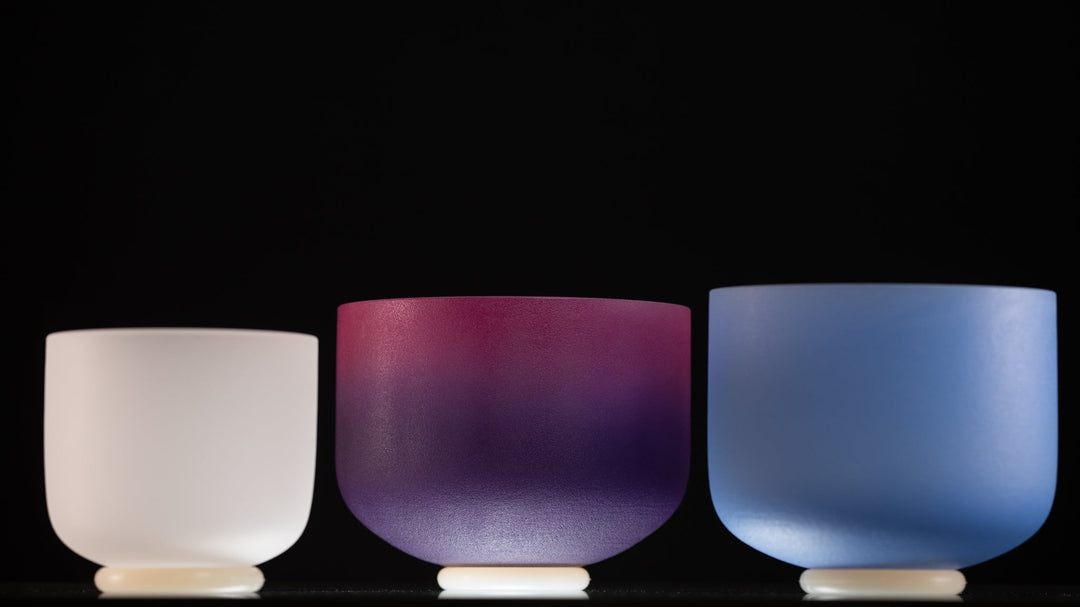
Do Singing Bowls Work? The Science of Sound, Vibration & Experience

Singing bowls can create an experience that feels remarkably powerful.
A sustained tone fills the room. Vibration may be felt through the floor or body. Attention begins to follow the sound. The breath may change. Thoughts may become quieter, or simply less important for a few moments.
But why does this happen?
And how much of what we experience with singing bowls can actually be explained by science?
The clearest answer is that several different things are happening at once.
There is the physics of sound: vibration, frequency, resonance, overtones and changes in sound pressure.
Then there is the human response to sound: hearing, attention, emotion, expectation, memory and physiological responses associated with relaxation.
Beyond what can be measured is the personal and spiritual experience of receiving sound, which may be deeply meaningful even when science cannot fully explain it.
These layers are often blended together in conversations about sound healing.
It helps to look at each of them separately.
We will look at:
-
What physically happens when a singing bowl produces sound
-
Why the vibration can sometimes be felt through the body
-
What resonance actually means
-
What scientific studies have observed
-
What we know and do not know about brainwaves and entrainment
-
Whether quartz has acoustic properties that differ from other bowl materials, and what can be said about claims of energetic properties
-
What research says about stress, anxiety and relaxation
-
Where scientific evidence ends and spiritual or personal interpretation begins
At Bowls of Sound and Sedona Crystal Temple, we have worked directly with singing bowls and sound healing since 2015.
Years of working with these instruments have given us a deep respect for what sound can evoke.
It has also taught us the value of distinguishing what we can measure, what research currently suggests, and what we experience personally.
We do not see those perspectives as being in conflict.
Understanding more about how sound behaves does not take away from the mystery of experiencing it.
If anything, it can give us another way to listen.
Sound Waves and the Body: What Is Actually Happening?

At the most basic level, a singing bowl is a vibrating object.
When a bowl is struck or played around its rim, its structure moves back and forth rapidly. This movement pushes and pulls on the surrounding air, creating sound waves.
Those waves travel through the room and reach our ears, where they are converted into the signals we perceive as sound.
What Is Frequency?
Frequency describes how quickly a vibration repeats and is measured in hertz (Hz).
One hertz means one vibration cycle per second.
A lower-frequency bowl is generally perceived as deeper in pitch, while higher frequencies are heard as higher tones.
But a singing bowl does not create only one frequency.
Along with its fundamental or dominant pitch, a bowl produces additional frequencies called overtones. The relationship between the fundamental tone and these overtones contributes to the bowl's distinctive timbre, or tonal character.
This combination of frequencies is part of what gives each bowl its distinctive sound and complexity.
Can You Physically Feel Sound?
Yes.
Sound is mechanical vibration, and when it is strong enough, we can sometimes feel it through the body as well as hear it through the ears.
With large, lower-pitched singing bowls, you may notice vibration through the floor, beneath the body, in the chest or belly, or simply as a broad physical presence in the room.
How noticeable that vibration feels can vary with:
-
The frequency of the sound
-
Its volume
-
Distance from the bowl
-
The acoustics of the room
-
Whether vibration is also traveling through the floor or another surface
-
Individual sensitivity
Feeling a vibration does not mean that the body's cells or organs are being “retuned” to the bowl's frequency.
It means that sound is interacting with the body through ordinary physical and sensory processes.
What Does Resonance Mean?
Resonance occurs when a system responds strongly to vibration at or near one of its natural frequencies.
A singing bowl itself is an example.
Its shape, size, wall thickness and material influence which vibration patterns persist after the bowl is struck or played. This is why a crystal singing bowl can continue sounding long after the mallet leaves the rim.
What Is Sympathetic Resonance?
Sympathetic resonance occurs when one resonant object begins vibrating in response to sound from another object with a sufficiently compatible frequency.
This is a measurable acoustic phenomenon that can be demonstrated with musical instruments.
In sound healing, however, the word resonance is also used in a broader way to describe a sound that feels emotionally, physically or spiritually significant to someone.
These are different uses of the same word.
A personal sense of resonance does not by itself demonstrate acoustic sympathetic resonance within the body.
Both can be discussed without confusing one for the other.

How Can Singing Bowls Affect the Mind and Brain?
Sound does not simply enter the ears and disappear.
The auditory system continuously analyzes pitch, rhythm, volume, location and changes over time. Sound can also influence attention, emotion, memory and arousal, helping explain why one sound may feel calming while another feels activating or uncomfortable.
With singing bowls, a sustained tone gives the mind something simple to follow.
Instead of moving constantly between thoughts and outside stimulation, attention may begin to settle on the changing sound of the bowl.
For some people, that shift alone can make meditation or relaxation feel more accessible.
Do Singing Bowls Change Brainwaves?
Possibly, although it is not as simple as saying that a singing bowl automatically moves the brain from “beta into alpha or theta".
Electrical activity in the brain can be measured using EEG, or electroencephalography. Researchers often describe patterns of activity using frequency ranges such as:
-
Delta: most prominent during deep sleep
-
Theta: often seen during drowsiness, memory processing and some forms of meditation
-
Alpha: commonly seen during relaxed wakefulness, especially with the eyes closed
-
Beta: common during active thought, attention and ordinary waking activity
These categories are useful, but brain activity is complex. The brain does not normally exist in only one “brainwave state,” and a particular frequency band does not correspond to one single emotional or spiritual experience.
Some singing bowl studies have reported shifts in EEG activity, including alpha, theta and delta bands. The research is still limited, however, and methods vary considerably.
These findings do not show that every singing bowl reliably produces a particular brainwave state.
What Is Brainwave Entrainment?
Brainwave entrainment describes the idea that rhythmic sensory stimulation may influence patterns of neural activity.
Auditory entrainment has been studied using repeated tones, rhythmic pulses and other forms of patterned sound.
Singing bowls can also produce natural rhythmic fluctuations or beats when nearby frequencies interact.
Why Might Singing Bowls Still Feel Meditative?
Several parts of the listening experience may contribute to why singing bowls can feel meditative:
-
Attention becomes focused on a sustained sound
-
There may be fewer competing sounds and distractions
-
Repetition and predictability can make the listening environment feel more familiar
-
Slow changes in sound can encourage sustained listening
-
The physical sensation of vibration may deepen awareness of the body
Simply lying quietly with the eyes closed and listening closely to a resonant instrument is already very different from most ordinary daily activity.
The singing bowl is part of that experience.
It does not need to be understood as a switch that forces the brain into a particular frequency.
Attention May Be One of the Most Important Pieces
There is something deceptively simple about listening to a bowl until its tone disappears.
The sound changes continuously.
It grows, shimmers, pulses and gradually becomes quieter until listening itself begins to meet silence.
The changing tone gives the mind something clear to follow without requiring complicated instructions.
You may notice thoughts becoming less compelling, the breath changing or a greater awareness of the body.
These experiences do not prove that the brain has entered one particular EEG state.
They do help explain why listening closely to sound can support meditation and sustained attention.
Crystal Singing Bowls, Quartz and Energy: What Do We Actually Know?

Quartz has been used in spiritual practice, meditation and healing traditions for generations.
In a crystal singing bowl, quartz is also the material from which the instrument itself is formed. It can produce long sustain, strong fundamental tones and complex overtones.
You may hear the bowl filling the room while also noticing vibration through the floor, chest, belly or surrounding space.
What Is Special About Quartz?
Quartz has several well-documented physical properties.
Crystalline quartz is piezoelectric, meaning it can generate a small electrical charge when mechanically stressed and can physically respond when an electrical voltage is applied. This is one reason quartz is used in watches, clocks and electronic frequency-control devices.
Does Quartz Amplify Energy?
The word energy is used differently in physics and spiritual practice.
In physics, energy has a specific measurable definition.
Within spiritual traditions, quartz may be described as amplifying intention, holding energy, supporting clarity or deepening meditation.
People may find these associations meaningful within spiritual or sacred practice. Science, however, has not established them as mechanisms by which crystal singing bowls heal the body.
Something can hold spiritual or personal significance without being a measurable physical mechanism.
Why Can a Crystal Singing Bowl Feel So Powerful?
The acoustic properties of a crystal singing bowl are already enough to explain many aspects of why the experience can feel powerful.
When played, the bowl becomes a resonant instrument.
Its shape, diameter, wall thickness and material influence how it vibrates and how long the sound continues.
That can create:
-
Strong fundamental tones
-
Long sustain
-
Rich overtones
-
Substantial volume
-
Audible pulsing when frequencies interact
-
Vibration that may sometimes be felt as well as heard
Together, these acoustic qualities can make the sound enveloping and give the listener something clear to focus on.
The Spiritual Relationship With Crystal
For many people, the relationship with quartz reaches beyond acoustics.
A crystal singing bowl may become part of meditation, prayer, ceremony, mantra, intention or simply a quiet moment of presence.
We honor that dimension of working with these instruments.
Understanding how a bowl behaves physically does not prevent someone from experiencing it as sacred. Its frequency can be measured and its vibration can be heard or felt, while the meaning of that experience remains personal.
What Does Research Say About Singing Bowls and Wellness?

The research on singing bowls is still limited, although more studies have appeared in recent years.
A 2025 systematic review identified 19 clinical studies involving singing bowls. The studies looked at anxiety, depression, sleep, pain, physiological measures and general well-being.
Many reported positive changes, although the methods, study populations and overall quality varied considerably.
Overall, the research is best described as promising, but not definitive.
Much of the published research has involved Tibetan or Himalayan singing bowls rather than quartz crystal singing bowls specifically.
Can Singing Bowls Reduce Stress or Anxiety?
Some studies suggest that singing bowls may support relaxation and reduce feelings of tension or anxiety.
In one observational study involving 62 adults participating in a Tibetan singing bowl meditation, participants reported significantly less tension, anger, fatigue and depressed mood after the session.
Because the study did not include a control group, however, it cannot tell us how much of the change came specifically from the singing bowls.
Quiet rest, meditation, the setting, expectations and other parts of the experience may also have influenced the result.
The improvement is still worth noting, even though the study cannot tell us exactly what produced it.
What About Heart Rate and Blood Pressure?
Researchers have also looked at physiological responses such as heart rate and blood pressure.
In a randomized crossover study involving 51 participants, listening to a Himalayan singing bowl before directed relaxation was associated with a greater reduction in heart rate and systolic blood pressure than beginning the relaxation period in silence.
Findings like this suggest that listening to singing bowls may support a relaxation response.
They do not establish singing bowls as a treatment for high blood pressure, cardiovascular disease or another medical condition.
Are the Health Benefits Proven?
Not yet.
Earlier reviews found encouraging results in areas such as anxiety, mood, heart rate and blood pressure, while also emphasizing how limited the evidence was.
The evidence base has grown, but larger and better-standardized studies are still needed.
So the most accurate position is:
Singing bowls may support relaxation and well-being, but the scientific evidence is still developing.
What Benefits Can We Reasonably Talk About?
Based on current research and common practice, singing bowls may be reasonably explored for:
-
Relaxation
-
Meditation and focused listening
-
Reducing feelings of tension
-
Greater awareness of the breath and body
-
Creating space for self-reflection
-
Supporting general well-being
These are very different claims from saying that a particular frequency cures illness, balances hormones or heals a specific organ.
What About Emotional Release?
People sometimes describe tears, memories, imagery or strong emotions arising during a sound bath.
Those experiences can be genuine and deeply meaningful.
What we cannot currently say scientifically is that singing bowls literally remove “stagnant energy” or that emotional release occurs through one established physiological mechanism.
A more grounded possibility is that slowing down, closing the eyes and listening closely may make emotions that were already present easier to notice.
For some people, that can be a powerful experience.
Sound as a Supportive Practice
Singing bowls can sit alongside other contemplative and wellness practices.
They may accompany meditation, rest, yoga, breath work, prayer or simply deep listening.
They do not need to promise a cure in order to have value.
Sometimes creating a few minutes in which the body can soften, attention can settle and sound can move through the room is enough.
Bringing Singing Bowls Into Your Daily Life
You do not need a formal sound bath or long meditation practice to use a singing bowl.
Even a few minutes of listening can slow the pace of the day and bring attention back to sound, breath and body.
Begin With One Tone
Gently chime the bowl and allow the sound to fade completely before playing it again.
Notice what changes as you listen.
You may become aware of the shoulders, jaw, breath, chest or belly.
You may notice thoughts continuing in the background.
There is no need to make anything happen.
Simply follow the sound until it disappears.
Use a Bowl for Meditation
A singing bowl can become a simple anchor for attention.
You might play one tone at the beginning of meditation, sound the bowl occasionally during practice, or allow a sustained tone to lead naturally into silence.
For people who find silent meditation difficult, the bowl can give the mind something clear to follow.
Pair Sound With Breathwork or Yoga
Singing bowls can accompany gentle breathwork, stretching or yoga.
A tone can mark the beginning or end of a practice without needing to become the focus of the entire experience.
If you are playing for yourself or others, keep the volume comfortable.
Crystal singing bowls can become quite loud, especially in small rooms or when played close to the body.
Create an Evening Listening Ritual
A few tones can also mark the transition into the evening.
Dim the lights, sit or lie comfortably, and allow a few tones to unfold slowly.
You do not need to play continuously.
Often the silence after the bowl fades becomes part of the experience.
Listen Without Needing an Outcome
It can be tempting to approach sound with a goal: to relax, clear energy, release emotion, meditate more deeply or reach a particular state.
Those intentions may be meaningful.
You can also listen without asking the bowl to produce a particular result.
Let the tone arrive and notice what, if anything, you experience.
Whatever rises is welcome.
Sometimes the whole practice is simply listening until the sound is gone.
Where Science and Spiritual Experience Meet

Singing bowls can be understood in more than one way.
The sound of a singing bowl can be described through physics. We can measure frequency, amplitude, overtones, resonance and vibration, and researchers can study changes in heart rate, blood pressure, mood, attention and brain activity.
Those measurements, however, do not fully describe what it feels like to lie quietly while a bowl resonates through a room.
Responses vary. A bowl may feel grounding, spacious or emotionally stirring, while sometimes the sound is simply beautiful to hear.
The body may soften, the breath may change, or nothing particularly dramatic may happen.
These experiences do not all require the same explanation.
What Does the Evidence Currently Support?
| Claim | What We Can Reasonably Say |
|---|---|
| Singing bowls may support relaxation | Supported by some preliminary research and commonly reported experience |
| Singing bowls may reduce tension or anxiety | Promising evidence, but more research is needed |
| Singing bowls can influence heart rate or blood pressure during relaxation | Observed in some small studies |
| Singing bowls automatically put the brain into alpha or theta states | Not firmly established |
| A specific frequency heals a particular organ | Not scientifically established |
| Quartz singing bowls scientifically amplify healing energy | Not scientifically established; energy amplification is better understood as a spiritual or experiential interpretation |
| People can experience singing bowls as deeply meaningful or sacred | A personal experience that does not require scientific validation |
Does Understanding the Science Change the Experience?
For us, learning more about acoustics has never made singing bowls feel less sacred.
Understanding the sound more deeply can enrich the way we listen.
A bowl can be understood as a resonant quartz instrument whose frequency, overtones and vibration can all be measured and studied.
Yet when the tone begins to fade into silence, the meaning of the experience may be harder to quantify.
We can keep careful measurement and personal experience distinct without treating either as less valuable.
A Grounded Way to Approach Sound Healing
A critical understanding of sound does not require dismissing its personal or spiritual meaning.
Spiritual traditions surrounding sound can be honored while remaining clear about the limits of current scientific evidence.
You can pay attention to your own response without assuming that everyone else will experience the sound in the same way.
A singing bowl can simply be a musical instrument, a focus for meditation or part of a sacred practice. Those meanings do not have to be identical for every listener.
Listen closely, notice the breath and what is present in the body, and let the experience remain your own.
Continue Exploring Sound and Singing Bowls
Our understanding of how sound affects the body, attention and nervous system is still developing.
Research is continuing to grow, but the experience of listening remains deeply personal.
You can continue with:
-
Crystal Singing Bowls: The Complete Guide for understanding notes, Hz, octaves, cents, bowl types and how to choose.
-
How to Choose a Crystal Singing Bowl if you are choosing your first bowl or looking for one that works with bowls you already own.
-
Explore Our Sound Healing Recordings to hear the bowls through our ad-free YouTube library.
-
Shop Crystal Singing Bowls to listen to recordings of individual bowls and compare their exact specifications.
Experience the Sound for Yourself
Sometimes the clearest way to understand a singing bowl is simply to listen.
Find a comfortable position and let the breath remain natural.
As the first tone arrives, listen without reaching for a particular outcome.
Notice what happens in the body, the mind and the quiet that follows.
Science can help us understand part of what is happening, but some aspects of the experience are still best discovered by listening.
Written by Joshua Esquivel & Tara Kaur | Bowls of Sound, Sedona, Arizona
Originally published October 30, 2024 · Updated September 2026