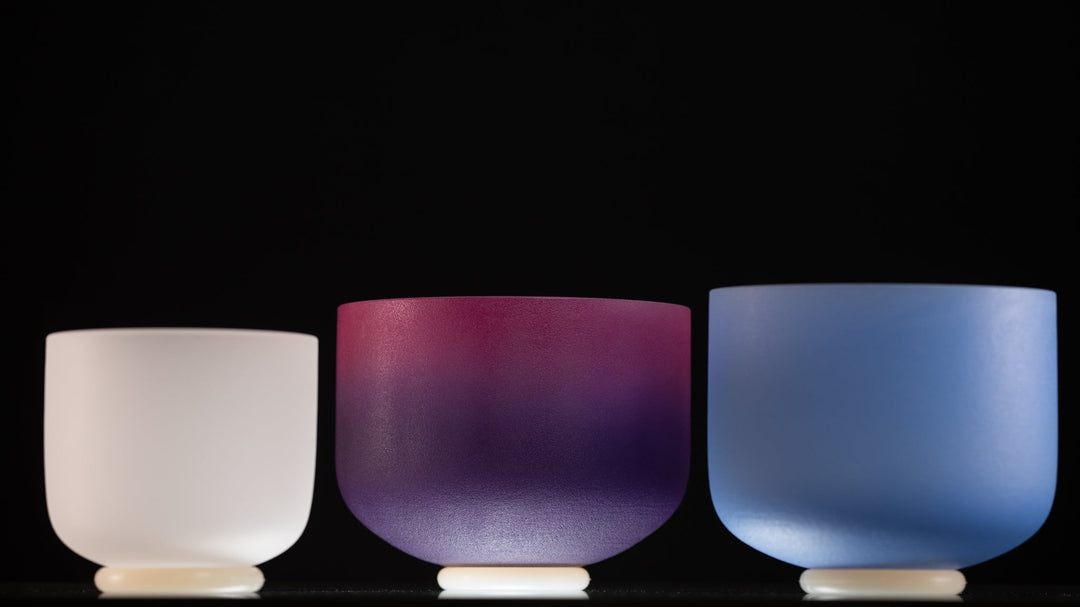
Crystal Singing Bowls: The Complete Guide
Crystal singing bowls are resonant musical instruments made from quartz. When gently chimed or played around the rim with a mallet, the bowl vibrates and produces a sustained tone that can be heard and, especially with larger bowls, physically felt.
They are used around the world for meditation, sound baths, yoga, personal practice, music and contemplative listening. Crystal singing bowls come in many sizes and styles, from traditional frosted quartz bowls to clear quartz, colored, etched and alchemical bowls that incorporate additional minerals, metals or other materials.
The deeper you go, the more there is to understand.
What does 432 Hz actually mean, and is frequency the same thing as musical note? What are cents? Why can two C bowls sound completely different?
Does a larger bowl always produce a lower tone? What is the difference between frosted and clear quartz? And what does scientific research actually tell us about singing bowls?
At Bowls of Sound, we have worked hands-on with crystal singing bowls since 2015 through personal practice, sound healing work and our Sedona-based bowl business. Every bowl we offer is individually played and evaluated. We work with notes, frequencies, octaves, tuning and harmonic relationships every day.
Throughout this guide, we make an important distinction between what can be measured acoustically, what scientific research currently suggests, and what comes from spiritual tradition or personal experience.
We believe these different ways of understanding sound can exist alongside one another without being confused for the same thing.
Frequency, pitch and harmonics can be measured with remarkable precision. The experience of listening is more personal. A tone may feel sacred, emotional, grounding or simply beautiful. Those experiences can be meaningful without needing to be presented as scientific facts.
What Are Crystal Singing Bowls?

A crystal singing bowl is a quartz-based musical instrument that produces a sustained resonant tone.
When the bowl is struck, or when a mallet creates friction around its rim, the bowl begins to vibrate. Those vibrations move through the surrounding air as sound waves, which we hear as tone.
Each bowl has its own acoustic voice.
Diameter, wall thickness, shape, manufacturing process and material composition can all influence fundamental pitch, sustain, volume, overtones and timbre, or tonal character. This is why two bowls of similar size may sound noticeably different.
A bowl may have a primary musical note such as C, D, F# or A, but the note alone does not tell you everything about its sound.
Its frequency in hertz (Hz), octave, tuning position in cents and overtone structure help describe more precisely what you are hearing.
These details matter even more when choosing several bowls that you want to play together.
Crystal singing bowls are commonly used for:
- Personal meditation and quiet listening
- Sound baths and sound healing practices
- Yoga and breath work
- Spiritual and contemplative practices
- Music and recording
- Therapeutic or wellness environments
- Building harmonic bowl sets
In practice, people choose bowls in very different ways.
For one person, the sound may be the deciding factor. Someone else may first be drawn to a particular note, color, material or visual presence. Spiritual associations can also be meaningful although we do not believe there is one required way to choose a bowl.
There is no single correct way to begin.
Understanding the acoustics gives you useful information, but a bowl ultimately has to be heard. Listen to its tone. Notice the sustain and overtones. Pay attention to how the vibration feels in the room and in your own body.
The measurements can tell you a great deal about a bowl.
Your own listening tells you something too.
How Do Crystal Singing Bowls Work?

Crystal singing bowls create sound through mechanical vibration and resonance.
When you gently chime a bowl or move a mallet around its rim the bowl begins to vibrate. Those vibrations move through the surrounding air as sound waves. When they reach our ears we hear them as tone.
A bowl does not produce only one frequency. Along with its primary pitch it produces additional frequencies called overtones. These contribute to the richness, shimmer and complexity we hear in the sound.
This is one reason a crystal singing bowl can sound far more complex than a single musical note.
What Is Resonance?
Resonance is the tendency of an object to vibrate more strongly at certain natural frequencies.
With a crystal singing bowl, diameter, shape, wall thickness and material all influence the way it vibrates. Once activated, the bowl may continue sounding well after the mallet has moved away, sometimes with a tone that will sing for minutes.
You may also feel some of that vibration, especially with larger, lower pitched bowls or when you are close to the instrument.
Sound is physical. It travels as mechanical vibration through a medium such as air, and lower frequencies can sometimes be experienced through the body as well as heard through the ears.
What Is Sympathetic Resonance?
Sympathetic resonance occurs when one resonant object begins to vibrate in response to sound from another.
You can hear and observe this with musical instruments. If one resonant object sounds near another that shares a compatible natural frequency, the second may begin to respond even though it was never directly chimed.
In sound healing, the phrase is sometimes used more broadly to describe the feeling that the body is “resonating” with a singing bowl.
That can be a meaningful way to describe what someone feels. It is different, however, from scientifically demonstrating that cells, organs or energy centers literally retune themselves to the frequency of a bowl.
We think it is important to leave room for the experience without presenting it as something that has been acoustically proven.
Why Can Crystal Singing Bowls Feel So Immersive?
A crystal singing bowl produces more than a single, isolated tone.
You may hear its primary pitch, layers of overtones, subtle changes in volume as the sound rises and fades, variations created by the mallet, and sometimes audible pulsing as nearby frequencies interact.
The result can feel less like listening to one note and more like being inside a field of sound.
During a sound bath or meditation, you may notice vibration around the head, chest or belly. You might feel it through the floor beneath you or simply sense the tone filling the space around you.
Attention may settle more fully into listening. The breath may change naturally. Tension may soften in the body.
Or you may experience the sound in an entirely different way.
There is no particular sensation you are supposed to have.
For us, this is one of the most interesting things about crystal singing bowls. Their sound can be measured through hertz, notes, octaves and cents, while the experience of hearing and feeling that sound remains personal.
What Are the Benefits of Crystal Singing Bowls?
People often describe crystal singing bowls as calming, centering and deeply immersive. They are commonly used in meditation, sound baths, yoga, relaxation practices and contemplative settings.
Listening can be both an auditory and a physical experience. Sustained tones may draw attention away from ongoing thought and more fully into the sound. With larger or lower-pitched bowls, some of the vibration may also be felt through the body.
What Does Research Suggest?
Scientific research specifically on crystal singing bowls is still limited and developing. Much of the available research has looked at singing bowls more broadly rather than quartz crystal bowls alone.
Some studies have reported effects associated with relaxation, including lower self-reported tension, anxiety or negative mood. Researchers have also measured changes in physiological markers such as heart rate and blood pressure in some settings.
These findings are interesting, but they do not establish crystal singing bowls as a treatment for medical or psychological conditions.
The clearest way to understand the current evidence is that sound may help create conditions that support relaxation, focused attention and meditation.
Experiences People Commonly Report
People describe many different experiences while listening to crystal singing bowls:
-
Relaxation: A sustained tone can provide a steady place for attention to rest and may make it easier to settle into stillness.
-
Deeper meditation: Some people find listening to sound more accessible than trying to meditate in complete silence.
-
Less mental chatter: Following changes in tone, vibration and sustain can shift attention away from repetitive thought, at least for a time.
-
Greater body awareness: Breath, posture, areas of tension and subtle physical sensations may become easier to notice.
-
Emotional spaciousness: Sound can sometimes create enough quiet for feelings to be noticed without immediately needing to change or interpret them.
-
Connection or stillness: For some listeners, receiving sound becomes contemplative, devotional or deeply spiritual.
The experience is not the same for everyone.
One person may feel profound relaxation. Another may simply enjoy the beauty of the sound. Some people notice strong vibration, emotion or imagery, while others mainly hear the tone itself.
All of those experiences can be valid.
What About Chakras and Energetic Healing?
Crystal singing bowls are often used within spiritual traditions that associate musical notes, colors or frequencies with chakras and other aspects of the subtle or energetic body.
These associations can provide a meaningful framework for meditation, intention and personal exploration.
At the same time, chakra-note relationships and claims that a particular frequency directly heals a specific organ or energy center have not been scientifically established.
In our own work, we leave room for these traditions without presenting spiritual associations as measurable acoustic facts.
A bowl can have a precisely measurable frequency while the meaning you experience through that sound remains personal, intuitive and sacred.
How Do You Choose the Right Crystal Singing Bowl?
Choosing a crystal singing bowl can be intuitive, but understanding a few practical details makes the process much easier.
The most important thing is to listen.
A bowl may be beautiful or have exactly the note you were looking for, but its actual voice is what you will hear every time you play it. Listen for a tone that naturally holds your attention. You may notice warmth, clarity, spaciousness, grounding or simply that you want to hear it again.
There is no single note or frequency that is right for everyone.
Start With How You Plan to Use the Bowl
How you intend to use a bowl can help narrow the choices. You may be looking for one for:
-
Personal meditation
-
Yoga or pranayama
-
Professional sound healing
-
Group sound baths
-
Recording or music
-
Travel
-
Adding to a bowl or set you already own
For a first bowl, we generally recommend choosing one that feels comfortable to play and sounds beautiful to you on its own.
If you already own singing bowls, matching becomes more important. Note, octave and tuning in cents can make a noticeable difference in how a new bowl sounds alongside the instruments you already have.
Size and Octave
Size influences the character of a crystal singing bowl, but diameter alone does not determine pitch.
Larger bowls often produce lower tones and more noticeable physical vibration. Smaller bowls often play higher and may sound lighter or more focused. There are many exceptions, though, because wall thickness, shape and manufacturing also affect the way a bowl vibrates.
This is why we pay attention to the bowl's actual note, frequency and octave rather than trying to predict its pitch from size alone.
Note and Frequency
A musical note such as C, D, F# or A identifies the bowl's pitch within the musical system.
Frequency, measured in hertz (Hz), tells us how many vibration cycles occur each second.
Two bowls can have the same note name and still sound very different. They may be in different octaves, or their pitches may sit at slightly different positions within the same note.
What Are Cents?
A cent is a small unit used to measure differences in musical pitch. There are 100 cents between one semitone and the next in equal temperament.
When we describe a bowl as being plus or minus a certain number of cents, we are showing where its pitch falls relative to the reference pitch for that musical note.
For example:
C+5 sits slightly above the reference pitch for C.
C-20 sits farther below it.
A difference of only a few cents may seem subtle when you hear one bowl by itself. Play several bowls together, and those small differences can become much easier to hear.
When we are helping someone build or expand a set, cents often tell us far more than the note letter alone.
What About Chakra Notes?
Many sound healing traditions associate particular musical notes with individual chakras.
These associations can be meaningful in meditation, intention and spiritual practice, but there is no single scientifically established or universally agreed-upon chakra-to-note system.
If a chakra or note association has meaning for you, it can certainly be part of the choice.
We would still listen carefully to the bowl itself.
A label can tell you its note. A frequency measurement can tell you its pitch. Neither can tell you whether you will love its sound.
Listen Before You Decide
Technical information becomes especially valuable when comparing bowls or building a set, but it does not replace listening.
We have seen bowls that look perfect on paper but are not the sound someone ultimately connects with. Another bowl may not be what they originally came looking for, yet as soon as they hear it, something about the tone holds their attention.
The measurements help you understand the bowl.
Listening helps you decide whether it is the bowl for you.
For a more detailed step-by-step approach, visit our How to Choose a Crystal Singing Bowl guide.
How Are Crystal Singing Bowls Used in Sound Healing?

Crystal singing bowls are widely used in sound healing, sound baths, meditation, yoga and other contemplative practices.
In a typical session, one or more bowls are played around a person or group, creating layers of sustained tone, vibration and silence. As the sound unfolds, attention may begin to move away from the stream of thought and more fully toward listening, breath and sensation in the body.
The bowls do not need to be extremely loud to create an immersive experience.
In our own work, we have found that some of the most meaningful moments come from listening closely to the room, allowing a tone to develop fully and leaving enough silence for what has already been played to settle.
What Happens During a Sound Healing Session?
A session may include individual crystal singing bowls, harmonic bowl sets, gongs, chimes or other resonant instruments.
As the tones move through the space, you may notice:
-
The breath becoming slower, deeper or simply different
-
Vibration through the body or the surface beneath you
-
Greater awareness of physical sensation
-
A quieter or more spacious quality of attention
-
Emotion, imagery or memories arising
-
Deep relaxation, and sometimes sleep
-
The simple pleasure of listening
Some sessions may feel deeply affecting. Others may be quiet and subtle.
There is no need to feel energy moving, see colors, enter a particular state or experience an emotional release for the session to have meaning.
Sometimes you simply listen and notice what is there.
Can Crystal Singing Bowls Heal the Body?
The meaning of the word healing depends greatly on the context.
Within wellness and spiritual traditions, it may describe relaxation, emotional processing, connection, inner stillness or a felt sense of returning to balance.
That is very different from claiming that a crystal singing bowl can diagnose, treat or cure a medical condition.
Scientific research on singing bowls is still developing. Some studies suggest that sound based practices may support relaxation and changes in certain measures related to stress or anxiety, but this does not establish crystal singing bowls as medical treatment.
For us, sound healing is best understood as a supportive practice, not a promise of a specific result.
The Role of Intention
Intention can influence the way you enter a sound healing session.
You may come with an intention to rest, listen, release something, become more present or simply receive the sound without asking anything particular of it.
For some people, the experience feels deeply spiritual. For others, it is primarily musical, meditative or relaxing.
There is no need to force meaning onto what happens.
Sound can simply be received.
Sometimes the practice is nothing more than allowing the body to be supported, letting the breath soften and listening.
How Are Crystal Singing Bowls Made?
Crystal singing bowls are made from quartz based material that is heated and formed into a resonant vessel.
The process is not the same for every bowl. Frosted, clear quartz, colored and alchemical bowls can be formed, finished and decorated using different methods, and some manufacturers use techniques that are proprietary.
The way a bowl is made can affect its sound as well as its appearance. Diameter, shape, wall thickness, material composition and finishing can all influence pitch, sustain, overtones, volume and overall tonal character.
How Are Frosted Crystal Singing Bowls Made?
Frosted crystal singing bowls are typically made from high purity quartz sand that is formed into a bowl using very high temperatures.
They are recognizable by their opaque white appearance and generally substantial walls. The playing rim is finished so the bowl can be struck or played continuously with a mallet.
Frosted bowls are often thicker and heavier than many clear quartz bowls. They can produce considerable volume and vibration that is easy to feel when you are close to the instrument.
Those qualities make them especially well suited to yoga classes, group sound baths and professional sound healing, where a bowl may need to carry through a larger space.
Not every frosted bowl is produced in exactly the same way, and the details of forming and finishing vary among manufacturers.
How Are Clear Quartz Singing Bowls Made?
Many clear singing bowls are made from high purity fused quartz that is shaped at very high temperatures using specialized quartz working methods.
The exact process depends on the manufacturer and the type of bowl being made.
Diameter, shape and wall thickness all matter. Even relatively small physical variations can change the way the finished bowl vibrates and ultimately how it sounds.
Clear quartz bowls often have thinner walls than traditional frosted bowls and can have a distinctly different voice. When listening, you may hear a tone that feels especially clear or luminous along with overtones that give the bowl additional depth and complexity.
How Are Alchemical and Colored Crystal Singing Bowls Made?
Colored and alchemical bowls begin with quartz but may also incorporate minerals, metals, pigments, coatings or other treatments.
Depending on the maker, materials such as gold, silver, platinum and titanium may be used alongside a wide range of mineral-based ingredients to create different colors, surfaces and visual effects.
There is no single manufacturing process used for every alchemical bowl.
Some materials may be applied to the surface, while others may be incorporated through methods developed by the manufacturer. Certain parts of these processes may also be proprietary.
For us, it is important to distinguish between what is known about the actual materials and construction of a bowl and the spiritual or energetic qualities associated with those materials.
A physical ingredient can be identified. The meaning or energetic association given to that ingredient comes from a different way of understanding the bowl.
Does the Way a Bowl Is Made Affect Its Sound?
Yes.
A crystal singing bowl's voice is shaped by a combination of physical characteristics, including:
-
Diameter
-
Wall thickness
-
Shape
-
Material composition
-
Manufacturing and finishing
-
Rim geometry
-
Small variations from one individual bowl to another
We hear these differences every day when playing and comparing individual bowls.
Two bowls can look almost identical and still have noticeably different voices. Even bowls with the same note and similar dimensions may differ in sustain, volume, overtones and in the way the tone develops as they are played.
This is why we evaluate each crystal singing bowl individually rather than assuming every bowl of a particular size, note or style will sound the same.
For a deeper look at the different manufacturing methods, visit our How Crystal Singing Bowls Are Made guide.
Are Crystal Singing Bowls Expensive?
Crystal singing bowls vary widely in price.
A simple frosted quartz bowl may be relatively affordable, while larger bowls, elaborate finishes and bowls incorporating precious metals or other specialized materials can cost considerably more. A professional set of several bowls can become a substantial investment.
But price does not tell you whether you will love the way a bowl sounds.
Why Do Crystal Singing Bowls Vary So Much in Price?
The price of a crystal singing bowl can reflect several things:
-
Bowl type: Frosted, clear quartz, etched, colored, handheld and alchemical bowls may involve different materials, processes and levels of finishing.
-
Size: Larger bowls generally require more material and can also cost more to manufacture, package and ship safely.
-
Materials and finishes: Precious metals, minerals, decorative treatments and specialized surfaces can add considerably to the price.
-
Production and finishing: More involved forming, finishing, decoration or proprietary processes may increase manufacturing costs.
-
Individual sound quality: Some bowls are especially responsive, have long sustain or possess a tonal character that makes them particularly appealing. A higher price however does not automatically mean better sound.
-
Tuning and availability: A bowl in a specific note, octave and tuning range may be harder to find, particularly when completing an existing set.
-
Individual measurement and testing: Knowing the actual note, frequency, octave and tuning in cents makes it much easier to compare bowls accurately and match them with instruments you already own.
-
Accessories and protection: Mallets, O-rings, carrying cases and the packaging required to ship a fragile instrument safely may also be reflected in the overall price.
Does a More Expensive Bowl Always Sound Better?
No.
An expensive bowl may contain rare materials, have an elaborate finish or require a more involved manufacturing process. None of those things guarantees that you will prefer its voice.
A comparatively simple quartz bowl can have beautiful sustain, clarity, responsiveness and presence.
What matters most is hearing the actual bowl you are considering.
When buying online, individual recordings are especially valuable. They let you hear the instrument itself rather than relying on a generic recording from another bowl of the same size, note or style.
At Bowls of Sound, each individual bowl listing includes a recording of the actual bowl being offered, along with its specific note, frequency, octave and tuning information when applicable.
What Are You Actually Paying For?
Instead of judging a bowl by price alone, look at what you are actually receiving.
Consider:
-
Whether you genuinely love its sound
-
Accurate note, frequency, octave and tuning information
-
Sustain, responsiveness and tonal character
-
Photographs of the actual instrument
-
A recording of the actual bowl whenever possible
-
Appropriate mallets and accessories
-
Protective packaging and reliable shipping
-
Experienced help when matching bowls or building a set
For a first bowl, there is usually no need to begin with the most elaborate or expensive option.
A well-made, responsive bowl that you genuinely enjoy hearing and playing is often the better choice.
How Do You Care for a Crystal Singing Bowl?
Crystal singing bowls are made to be played, but quartz can chip, crack or break if a bowl is dropped or struck against another hard surface.
Care mostly comes down to gentle handling and protecting the bowl when it is stored or transported.
Handle the Bowl Carefully
Carry a crystal singing bowl with two hands, especially when it is large or heavy.
Avoid lifting a large bowl by the rim with one hand or carrying several unprotected bowls at the same time.
When setting a bowl down, place it gently on a stable surface with an appropriate O-ring, cushion or other support underneath.
How Do You Clean a Crystal Singing Bowl?
For ordinary dust and fingerprints, start with a soft microfiber cloth.
When more cleaning is needed, mild soap and water can be used on many plain quartz bowls. Dry the bowl completely afterward with a soft cloth.
Avoid abrasive scrubbers and harsh cleaning products, especially on bowls with polished, painted, plated, etched or other specialized finishes.
Alchemical, metallic, painted and artistically finished bowls may require different care, so follow the instructions provided for that particular instrument.
Store and Transport Bowls Safely
When a bowl is not being played, keep it somewhere stable where it is unlikely to be knocked over or bumped.
For transportation, use a properly padded case or bag.
If bowls are nested, place enough cushioning between them that the quartz surfaces cannot touch or strike one another while being carried.
Never force one bowl inside another.
Use the Right Mallet
Different mallets can create very different tones and can also chime or press against the bowl with different levels of force.
You do not need to chime a crystal singing bowl hard.
A gentle chime can produce a strong, sustained tone, especially with larger bowls. When playing around the rim, use steady pressure and allow the tone to build gradually rather than forcing more volume from the bowl.
If the sound becomes harsh, unstable or excessively loud, reduce the pressure, speed or both.
Do Not Force More Volume
More volume is not necessarily better.
Crystal singing bowls can become extremely loud when played continuously around the rim, especially in smaller rooms or when you are close to the instrument.
Let the sound open naturally and give the bowl time to resonate.
Gentler playing also tends to create more space around the tone, making it easier to hear the sustain and overtones rather than simply increasing volume.
Check Your Bowl Periodically
Before playing, especially after transporting a bowl, take a moment to inspect the rim and body.
If you notice a significant crack, chip or other structural damage, stop playing the bowl until you can determine whether it is safe to continue using.
Most crystal bowl care is simple. Handle the quartz gently, protect it from hard surfaces and do not force the sound.
With thoughtful use and storage, a crystal singing bowl can remain a beautiful instrument for many years.
How Can You Use Crystal Singing Bowls in Daily Life?
A crystal singing bowl does not need to be reserved for a formal sound bath or meditation.
Even a few minutes of listening can bring a moment of stillness into an ordinary day.
Begin the Day With Sound
You might play your bowl once or twice in the morning and allow the tone to fade completely before moving into the day.
You do not have to ask anything particular of the experience.
Listen to the tone, notice the breath and pay attention to the quiet that follows.
Use a Bowl for Meditation
A singing bowl can provide a natural point of focus during meditation.
You can gently chime the bowl at the beginning of your practice, play it periodically or allow one sustained tone to lead into silence.
For people who find silent meditation difficult, following a tone can offer a simple place for attention to rest.
Pair Sound With Breathwork or Yoga
Crystal singing bowls can accompany gentle breathwork, stretching or yoga.
A single tone can mark the beginning or end of a practice, while several bowls can surround the practice with layers of sound.
If you are playing for others, keep the volume comfortable. Crystal singing bowls can become considerably louder than they may seem from the player's position.
Create an Evening Ritual
A softly played bowl can also become part of an evening practice.
Lower the lights, find a comfortable position and allow a few tones to unfold slowly.
There is no need to play continuously.
Sometimes the silence after a bowl fades becomes part of the experience.
Play With Intention
Some people enjoy pairing a bowl with an intention, mantra, prayer or contemplative question.
Others prefer to play without assigning any particular meaning to the sound.
You may simply listen and notice where the vibration seems to meet you: around the head, through the chest or belly, in the room around you, or perhaps primarily through the ears.
There is no place you are supposed to feel it.
Explore More Than One Bowl
If you begin playing several bowls together, notes, octaves, cents and harmonic intervals become increasingly useful.
Two bowls may create a spacious consonant relationship, noticeable tension, audible pulsing or an unexpected texture depending on their frequencies and how they interact.
Over time, you may begin hearing more than the individual bowls themselves. You start noticing what happens between the tones: where they blend, where they pull against one another and where new textures seem to emerge.
A Crystal Singing Bowl Is More Than Its Measurements
We can measure a singing bowl with remarkable precision.
Its frequency, musical note, octave and tuning in cents can all be identified. We can also examine its size, material, sustain and overtones.
That information matters, especially when comparing bowls or building a set.
But measurements cannot fully describe what it is like to hear a bowl in person.
There is the first arrival of the tone, the way it moves through the room and the silence that follows when the vibration finally fades. You may notice the breath become quieter or your attention settle more deeply into listening.
For us, understanding the acoustics does not diminish the mystery of sound.
It gives us another way to listen more closely.
Know the measurements.
Then listen to the bowl.
Crystal Singing Bowl FAQ
What is the best crystal singing bowl for a beginner?
For a first bowl, choose one that is comfortable to play and whose sound you genuinely enjoy.
A frosted quartz bowl is often a practical starting point because it is generally easy to activate, produces strong sound and is available in many sizes and notes.
The most important thing is to listen to the actual instrument whenever possible.
What note should my first crystal singing bowl be?
No single note is best for everyone choosing their first bowl.
Choose based on the sound you are naturally drawn to rather than assuming you need a particular chakra note or frequency.
If you already own bowls, note, octave and cents become more important because the new bowl needs to work musically with what you already have.
Does the size of a crystal singing bowl determine its note?
Not completely.
Larger bowls often produce lower pitches and smaller bowls often produce higher ones, but diameter is only one factor. Wall thickness, shape and manufacturing also affect pitch.
The bowl's actual note, frequency and octave are more reliable than size alone.
What does Hz mean on a crystal singing bowl?
Hz, or hertz, measures frequency.
One hertz equals one vibration cycle per second. A bowl with a fundamental frequency of 220 Hz completes approximately 220 vibration cycles each second.
Frequency describes the bowl's pitch more precisely than the note name alone.
What do plus and minus cents mean?
Cents describe how far a bowl's pitch sits above or below the center of a musical note.
A bowl marked C+10 is slightly above the center of C, while C-20 is slightly below it.
Cents become especially useful when building sets or pairing bowls harmonically.
Are 432 Hz crystal singing bowls better than 440 Hz bowls?
There is no strong scientific evidence showing that bowls tuned around a 432 Hz reference are inherently more healing than bowls tuned around 440 Hz.
The numbers describe different tuning references.
Some listeners simply prefer the sound or approach of one tuning reference over another. Either can be used in musical, meditative or spiritual practice.
Are crystal singing bowls associated with chakras?
Many modern sound healing traditions associate musical notes with specific chakras.
Chakra-to-note associations can offer a useful framework for meditation or intention, although different traditions use different mappings. These relationships have not been scientifically established.
You do not need to feel a particular note in a particular part of the body.
Can crystal singing bowls be played together?
Yes.
Multiple crystal singing bowls can create beautiful harmonic relationships when their notes, octaves and tuning work well together.
Octaves, thirds and fifths often sound especially balanced and consonant together. Bowls with frequencies that sit very close together can produce audible pulsing or beating.
When building a set, listening to the actual bowls together is ideal.
How loud should a crystal singing bowl be played?
Crystal singing bowls do not need to be played loudly to create an immersive experience.
A gentle chime or slow rim technique can produce substantial volume and sustain.
If the sound feels harsh, piercing or uncomfortable, reduce the playing force, pressure or speed.
Can crystal singing bowls crack or break?
Yes.
Quartz is durable but brittle. A bowl can chip or crack if it is dropped, struck against another hard surface or handled roughly.
Use appropriate padding, transport cases and O-rings, and avoid allowing bowls to knock against each other.
How do I know if a crystal singing bowl is high quality?
Listen for a tone that is clear, stable and responsive, with sustain and overtones that you enjoy.
Also look for transparent specifications such as:
-
Actual note
-
Frequency in Hz
-
Octave
-
Tuning in cents
-
Accurate photographs
-
A recording of the actual bowl
-
Clear information about materials and manufacturing
Price alone does not determine quality.
Should I buy one crystal singing bowl or a set?
If you are new to singing bowls, starting with one well chosen bowl is often enough.
A set becomes useful when you want to explore harmony, create longer sound journeys or work professionally with groups.
If you already own a bowl, adding one carefully chosen complementary instrument may make more sense than buying an entire set at once.
Continue Exploring Crystal Singing Bowls
There is a lot to discover about crystal singing bowls, but you do not need to understand everything before choosing one.
Start by listening.
Notice which tones you naturally want to hear again. As you spend more time with the bowls, things like notes, frequencies, octaves, cents and harmonic relationships will begin to make more sense.
If you would like to explore further:
-
How to Choose a Crystal Singing Bowl for practical guidance on choosing your first bowl or finding the right bowl to add to your collection.
-
How to Choose a Crystal Singing Bowl Set to learn how notes, octaves, cents and harmonic relationships can help you build a set.
-
Shop Crystal Singing Bowls to listen to individual bowls and explore them by note, size, style and octave.
-
Hz to Note Finder to enter a frequency and find its musical note, octave and tuning in cents.
Would You Like Help Choosing?
If you are unsure which bowl feels right, or you are looking for a bowl that will sound beautiful with instruments you already have, we are happy to help.
We offer complimentary one-on-one crystal singing bowl consultations from Sedona. We can listen with you, compare different bowls and help you narrow the possibilities based on what you are drawn to and what will work well with your existing instruments.
Book a Complimentary Singing Bowl Consultation

Written by Tara Kaur & Joshua | Bowls of Sound, Sedona, Arizona
Originally published December 2024 · Updated September 2026